




1. Introduction: The Crisis of Purpose in the Modern World
In the modern professional landscape, we carry a brain that is the product of six million years of evolution. Our ancestors survived by maintaining a rigorous connection to reality—detecting predators, anticipating weather, and identifying food sources. Today, while physical survival is largely assured, we face a more insidious danger: our minds have become unmoored from the environment. We have entered a “secularized world” where the traditional structures of organized religion no longer provide a default sense of direction. This lack of a defining purpose causes most professionals to “flounder,” trapped in a state of aimlessness that makes them vulnerable to social games and internal fantasies.
To navigate this landscape, one must adopt the perspective of the “Radical Realist.” Most people are “Deniers”—those who believe human nature is essentially angelic and that success is a matter of pedigree or shortcuts. Radical Realism, by contrast, acknowledges that our greatest challenges come from people and their “tricky psychology.” It asserts that turning inward to one’s biological reality is superior to the delusions of modern culture, which suggests that work should always be “fun” or that boredom is a failure. The thesis of this strategy is clear: discovering your calling is the non-negotiable first step toward Mastery. It is the only way to transform from an interchangeable employee into an irreplaceable force. This journey begins not with a search for external opportunities, but with a return to your biological origins.
2. The Primal Seed: Understanding Your Genetic Uniqueness
From a strategic perspective, your greatest competitive advantage is your uniqueness. You are a “one-time phenomenon” in the history of the universe; your genetic makeup has never occurred before and will never be repeated. This individuality is not a social construct but a biological imperative that seeks expression.
Robert Greene describes this phenomenon using the metaphor of the Seed: “At your birth a seed is planted. That seed is your uniqueness. It wants to grow, transform itself, and flower to its full potential.” This “Inner Force” possesses three defining attributes that must be harnessed for career strategy:
- Primal Inclinations: These are deep-seated forces that draw you toward specific experiences and repel you from others. They function as a pre-verbal compass for your career.
- Assertive Energy: This is the natural drive toward self-expression. When this energy is blocked, it manifests as frustration or depression; when channeled, it fuels the pursuit of Mastery.
- Destiny: In Greene’s framework, destiny is the fulfillment of the Life’s Task. It is the realization of the “voice” within that guides you toward what you were meant to accomplish.
3. The Archaeology of the Self: Reconnecting with Childhood Inclinations
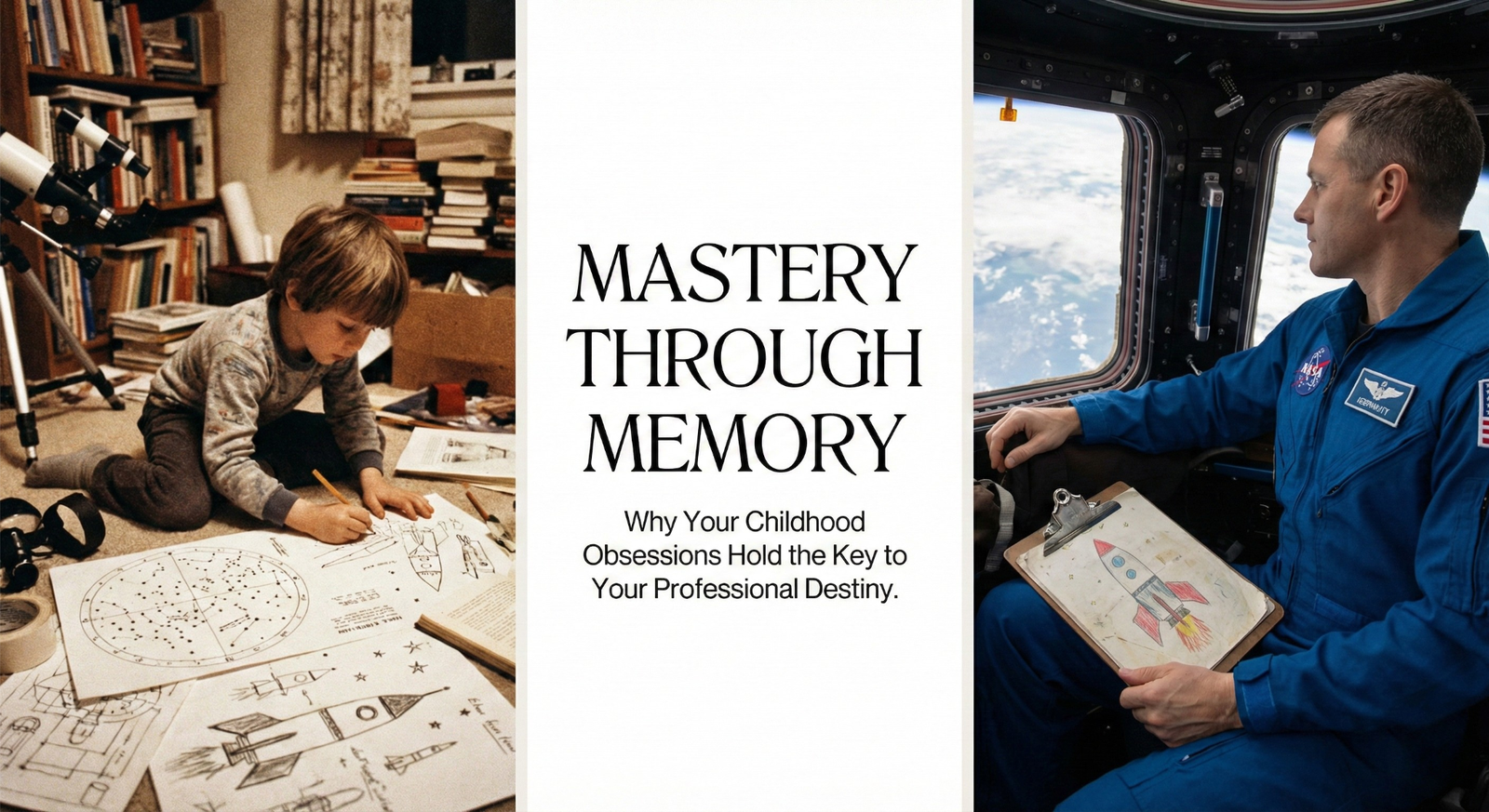
Identifying a high-value career path requires a disciplined “Archaeology of the Self”—a process of digging beneath layers of social conditioning to uncover your “Impulse Voices.” As Abraham Maslow noted, children know exactly what they like and dislike before their tastes are “infected by the desires of other people.” To find your Life’s Task, you must identify these visceral reactions before they were obscured by the need for parental or social approval.
Signals of the Primal Core
| Signal Type | Manifestation in Reality |
| Visceral Reactions | A sudden, deep physical attraction to an object or environment, such as Marie Curie being “transfixed” by the chemistry instruments in her father’s glass case. |
| Unusual Curiosity | A subject that stimulates a degree of interest far beyond that of peers, such as V.S. Ramachandran’s childhood obsession with the rarest “anomalous” seashells. |
| Spiritual Longings | Work that affects you on a “religious” level, similar to John Coltrane being touched to the core by the “voice” of Charlie “Bird” Parker’s saxophone. |
| Feelings of Power | A sense of heightened aliveness or personal strength during a specific action, such as Martha Graham feeling expressive only through movement rather than words. |
4. Navigating the False Path: Resistance and Rebellion
A “False Path” is a career choice motivated by external validation—money, fame, or parental approval—rather than internal inclination. Greene warns: “A false path in life is generally something we are attracted to for the wrong reasons—money, fame, attention, and so on.” The strategic “So What?” is clear: a false path erodes your confidence and ensures you will fall behind your competition, as you lack the obsessive interest required to stay at the vanguard of your field.
Strategic Mastery requires an act of Active Rebellion. This is not a mere emotional outburst, but a healthy re-channeling of aggressive energy into the establishment of an independent identity. You must scoff at the need for public approval and feel a calculated resentment toward parental or social forces that foist an “alien vocation” upon you. By rebelling against these “counterforces,” you reclaim the energy necessary to pursue a path that aligns with your unique chemistry.
5. Case Study in Resilience: Robert Greene’s Journey to the 48 Laws
The path to a Life’s Task is rarely linear; it is often a “wandering” journey where diverse experiences serve as the fertilizer for a future calling. Robert Greene’s career path exemplifies this unconventional resilience:
- 1970s–1980s: Greene pursued journalism but was told by an editor he was “not writer material” because his style was too “bizarre.”
- The Wandering Years: He totaled approximately 60 different jobs, including construction in Greece, hotel reception in Paris, detective work, and Hollywood story development.
- 1995: The “Click” Moment: While walking in Venice with producer Joost Elffers, Greene pitched an idea to expose the “games of power” he had witnessed across his 60 jobs.
- The Synthesis: At age 36, he realized his diverse, menial experiences were actually “seeds” that allowed him to see the reality of human nature.
Greene’s pivot illustrates that Mastery can begin at any age. He poured “all the horrible bosses” and lessons from his varied career into a single work, proving that an “unconventional path” provides the most fertile ground for seeing the world as it truly is.
6. Action Plan: The Daily Law of Discovery
To convert philosophical realization into professional dominance, you must implement the “Mastery Starter Kit.” This plan is based on the biological reality that our brains were designed for Mastery over six million years of development.
- Identify Your Anomaly: Embrace what makes you “weird” or “different.” Like V.S. Ramachandran, who studied neurological disorders to see the brain’s secrets, your source of power lies in your “strangeness,” not your ability to conform.
- Analyze Your Heroes: Identify work that affects you on a “religious” level. Use these models to uncover your own spiritual and emotional longings.
- Submit to the Learning Curve: When entering a new field, revert to a “childlike feeling of inferiority.” This is a strategic state of dependence where you drop all preconceptions and hungrily absorb knowledge from those who know more.
- Engage in Resistance Practice: This is the path of the Master. Move toward your weaknesses. Become your own worst critic and invent exercises that force you to confront the elements of your craft that you are not good at.
The Daily Law: “Mastery is a process and discovering your calling is the starting point.”
7. Purpose as the Ultimate Power
In a globalized world full of “interchangeable people,” a clear Life’s Task is the ultimate strategic advantage. It makes you irreplaceable. When your work is tied to a personal need and a unique combination of skills, your energy is directed toward continuous improvement, creating what John Keats called “Negative Capability”—the power to endure mysteries and uncertainties without reaching for easy, false answers.
A sense of purpose acts as a radar, guiding every career decision and protecting you from the “deadening dynamic” of social conformity. This is not a selfish pursuit; it is a biological and social necessity. The prosperity of the human race depends on the diversity of specialized skills that only you can provide. To achieve this state of power, you must cultivate the craftsman’s ethic and commit to the lifelong journey of self-discovery.
“Become who you are by learning who you are.” — Pindar