




1. Introduction: The Crisis of Aimlessness and the Return to Reality
From an evolutionary perspective, the human brain is an instrument of survival designed to detect changes in the environment and anticipate reality. However, in the modern landscape, this biological tool is being blunted. We are currently witnessing a crisis of aimlessness, where the mind turns inward, fueled by “false notions” and the “Human Comedy” of social delusions. Modern culture saturates the mind with toxic fantasies: the myth that work should be “fun,” the lie that hierarchies are a thing of the past, or the egalitarian delusion that everyone is equal in talent and potential. To enter the work world burdened by these fantasies is to ensure a “slap in the face” from reality.
The strategic cost of this aimlessness is “hyperintention”—a psychological paradox where the desperate, ego-driven pursuit of money or status actually repels success. When you lack a “Life’s Task,” you become a “distracted scanning animal,” vulnerable to the insecure maneuvers of colleagues and the deadening dynamic of your own burnout. Survival in this environment requires a transition to radical realism. This is not a search for “self-help”; it is an anatomical excavation of your “primal inclinations” to find a mission that anchors you in the real world.
2. The Primal Seed: Defining Your Unique Genetic Phenomenon
Mastery is not a choice; it is a biological imperative. At birth, a specific genetic seed is planted within you—a one-time phenomenon in the history of the universe that will never be repeated.
“At your birth a seed is planted. That seed is your uniqueness. It wants to grow, transform itself, and flower to its full potential.”
You must view yourself as an “anomaly,” much like the Xenophora organism mentioned in the studies of V.S. Ramachandran. Just as the Xenophora occupies a specific ecological niche for survival, your uniqueness serves an evolutionary purpose. However, most individuals succumb to the “False Path,” allowing the “inner force” of social pressure, parental anxiety, or the need for public approval to override their biological reality. To ignore your “seed” is to ensure that your energy wanes and your work remains mediocre. Identifying this genetic phenomenon is merely the diagnostic stage; the treatment requires the courage to pursue a total immersion in what viscerally attracts you.
3. Case Study in Immersion: Daniel Everett and the “Other”
The career of anthropologist-linguist Daniel Everett provides a clinical example of “radical realism” through attraction. Growing up on the California-Mexico border, Everett felt a primal pull toward Mexican culture—not as a superficial hobby, but as a visceral fascination with “the Other.” He was transfixed by the sounds, the food, and the distinct social manners that differed from his own Anglo world.
Everett’s success was predicated on his refusal to allow his interest to be “infected by the desires of other people.” He sought the “heartbeat” of the culture by diving into its most minute details. This was not an intellectual exercise; it was total immersion. By treating his fascination as the primary data of his life’s work, he transformed from a curious outsider into an insider whose understanding of human evolution was grounded in the marrow of reality. To achieve similar results, you must identify your own version of Everett’s “Other” by listening to the “impulse voices” that signal your true chemical attraction to a field.
4. Decoding Your “Impulse Voices”: The Archaeology of Interest
To find your Life’s Task, you must perform an archaeological dig on your own history, stripping away the layers of social conditioning to find the “impulse voices” identified by Abraham Maslow. These are the internal signals that indicate a path “not infected by the desires of others.”
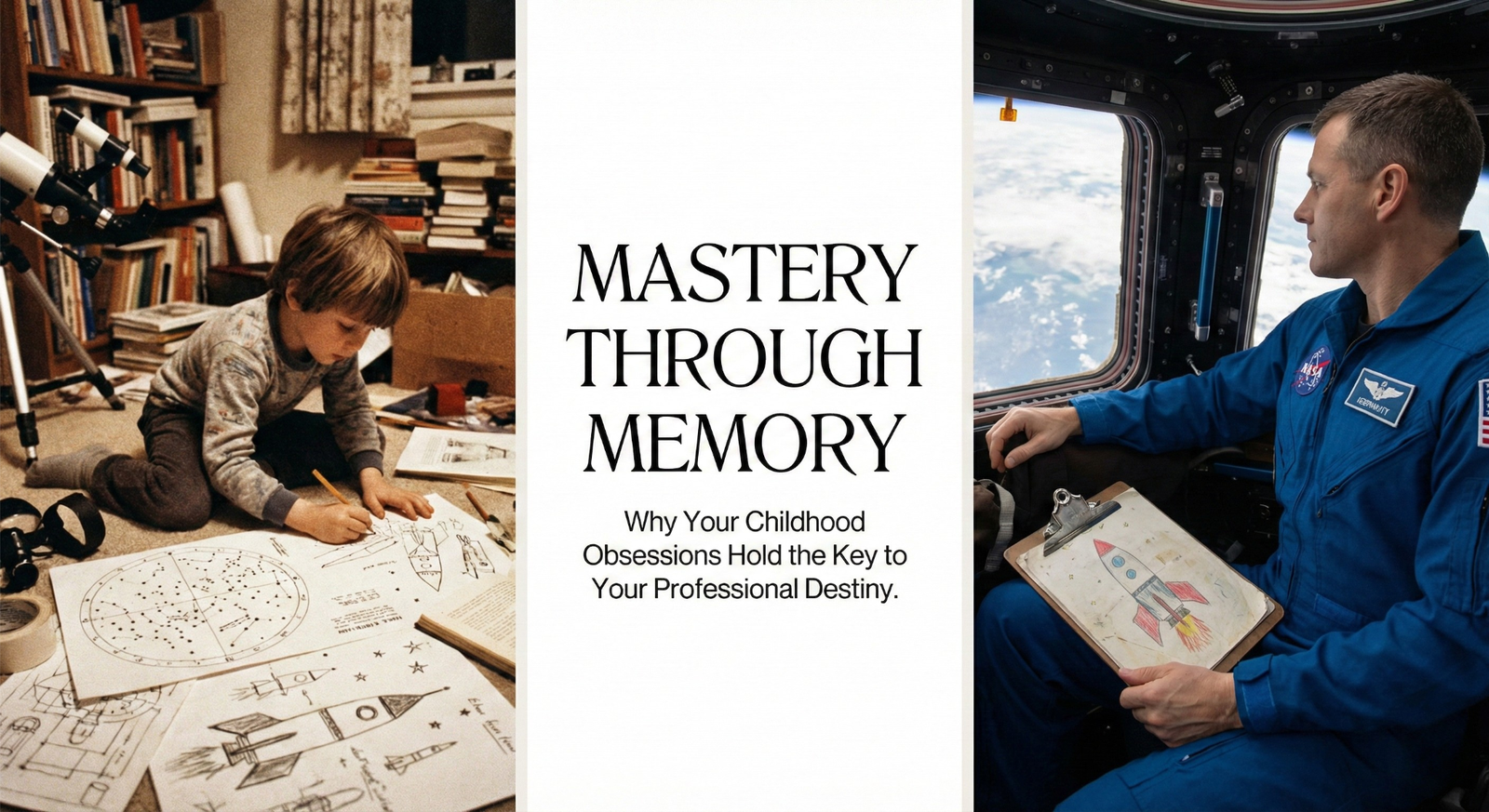
- Examine Childhood Obsessions: Identify activities you could perform for hours without fatigue, like Marie Curie’s childhood fixation on laboratory instruments.
- Audit Visceral Reactions: Distinguish between shallow “intellectual curiosity” and the “visceral reactions” that signal a deep chemical mesh with a subject.
- Identify Resistance and Negative Spurs: Use your sense of rebellion against “false paths” as fuel. As 50 Cent observed, every negative is a positive if it sharpens your sense of purpose.
- Analyze Your Heroes: Examine models like John Coltrane. His connection to Charlie Parker’s music was not just professional; it was a “religious-like quest” to express his own internal voice.
- Limitations as Indicators: Sometimes your calling appears through what you cannot do. Like Temple Grandin, whose autism forced her to focus on visual thinking and animals, your “deficiencies” can lead you to a unique ecological niche that others cannot occupy.
This process is a prerequisite for the “Apprenticeship” phase—the period where you must submit to reality to transform your mind.
5. The Strategy of Total Immersion: Moving from Outsider to Insider
Finding an interest is strategically useless without the subsequent “Apprenticeship.” This is a “submission to reality” where you move from the “Outside”—seeing only the superficial rules—to the “Inside,” where you feel the “heartbeat” of the field.
| The Outsider Perspective (Appearances) | The Insider Perspective (Reality/The Heartbeat) |
| The keyboard looks intimidating; a collection of slow, tedious rules. | The rules are internalized; the field becomes part of the nervous system. |
| Operates with a passive, “formal education” mindset. | Practices “Resistance Practice” by attacking weaknesses and deficiencies. |
| Distracted by political games and surface-level “visuals.” | Gains a “Fingertip Feel” (Mar 15); the game “slows down” (Jan 30/Mar 2). |
| Sees only the parts; moves with hesitation. | Sees the “field of forces” and the overall dynamic (Mar 30). |
Total immersion is the only path to “Dimensional Thinking.” By expanding your knowledge into “auxiliary fields” (Mar 1), you provide your brain with the fuel for high-level associations. This deep focus allows the “game to slow down,” providing a “fingertip feel” that cannot be replaced by technology or “magical shortcuts.”
6. Conclusion: Mastery as Salvation in a Changing World
The pursuit of your Life’s Task is a “religious-like quest” (Jan 15) and a form of “salvation” (Jan 20) in an increasingly secularized world. We must create our own world or die from the inaction of our own naiveté. Mastery is the only means of determining our own fate rather than remaining “distracted scanning animals” (Feb 20) whose powers have been reversed by technology and wishful thinking.
The choice is final: you either become a “Master of your fate” through the “slow accumulation of skills,” or you remain a prisoner of recurring patterns, bitter and damaged by the “Human Comedy.” Radical realism is the only liberating force.
Knowing in a deep way who you are, your uniqueness, will make it that much easier to avoid all of life’s other pitfalls.